
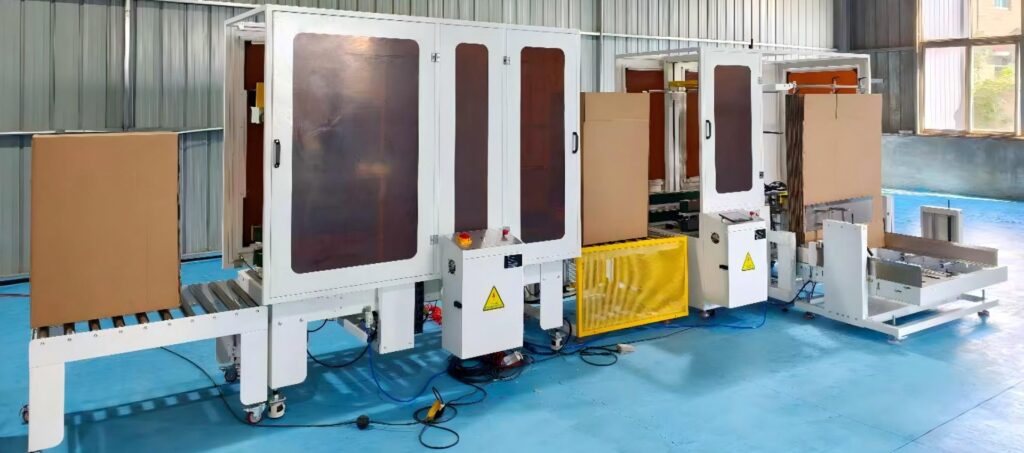
How to Plan a Cork Automation Line With I/O Signal Integration
A cork automation line is not simply several machines placed in sequence. Feeding, inspection, laser marking, counting, packaging, and carton handling must communicate with each other so that corks move through the process in the correct order.
When machines operate independently, operators may need to start, stop, load, unload, or transfer materials between stations. This can create waiting time, material accumulation, and inconsistent production rhythm.
A connected cork automation line uses equipment interfaces and I/O signals to coordinate the process. Each module can send or receive signals that confirm whether it is ready, running, paused, full, stopped, or in fault condition.
Fangshiheng provides equipment for cork feeding, inspection, laser marking, visual counting, packaging, and custom automation integration. The final line design should be based on the customer’s cork size, production target, quality-control process, factory layout, and existing equipment.
Why Machine Communication Matters
In a production line, the next machine cannot always accept material immediately.
For example, a feeder should not continue supplying corks if the inspection machine is paused. The laser marking machine should not receive corks if its positioning station is not ready. The counting machine should not release a completed batch if the packaging station is still sealing the previous bag.
Without communication between modules, corks may accumulate at transfer points. Operators may need to remove material manually or restart machines after a blockage.
A cork automation line with coordinated I/O signals helps each machine respond to the condition of the next process.
How I/O Signal Integration Works
I/O means input and output signals exchanged between machine control systems.
An input signal tells a machine about an outside condition. An output signal sends a machine status or command to another device.
In a cork production line, the I/O connection may support functions such as:
- Start and stop coordination
- Upstream pause when the downstream machine is full
- Restart after the downstream machine becomes ready
- Material arrival confirmation
- Fault alarm transfer
- Emergency-stop coordination
- Batch-release control
- Reject-system status
- Packaging-machine ready signal
- Finished-product discharge signal
The exact I/O list depends on the selected machines and the customer’s required process. It should be confirmed during line design.
A Typical Cork Automation Line Process
A complete cork automation line may include several connected modules.
The line can begin with a cork centrifugal feeder that supplies cork stoppers in a more controlled flow. The feeder can be matched with the receiving method of the next machine.
The corks may then enter an inspection station. Depending on the required quality-control process, the line can include diameter inspection, visual inspection, reject sorting, or other confirmed checks. Related equipment can be reviewed in Fangshiheng’s Cork Processing Machinery range.
Accepted corks can continue to a CO2 Cork Stopper Marking Machine for logo, text, code, or pattern marking. The marking station can send a signal when it is ready to receive the next cork or pause upstream feeding when its internal process is occupied.
After marking, a cork visual counting machine can control the quantity of corks released for each package or batch.
The counted corks can then enter an automatic cork packaging machine for bagging, vacuum extraction, optional SO2 filling, sealing, and downstream transfer.
The final line arrangement should be confirmed according to the customer’s actual process. Not every factory needs every module.
Coordinating Feeding With Inspection
The front-end feeder is important because it determines whether the next machine receives a stable cork flow.
When the inspection module is ready, it can send a ready signal to the feeder. The feeder can then continue delivering corks. If the inspection system detects a fault, becomes full, or needs to pause, it can send a stop or hold signal upstream.
This helps prevent too many corks from entering the inspection area at the same time.
The feeder outlet, transfer height, cork orientation, and I/O signal logic should be planned together. A stable mechanical connection alone is not enough when the line needs automatic pause and restart control.
Coordinating Marking With Downstream Equipment
Laser marking is a value-added process. The marking station should receive corks only when positioning, laser processing, and discharge conditions are ready.
The marking machine may need to pause if a downstream inspection or counting process is not ready. In the same way, the feeder and inspection module may need to pause if the marking station reaches its capacity.
This signal coordination helps avoid several common problems:
- Cork accumulation before the marking position
- Corks entering before the fixture or positioning station is ready
- Marked corks waiting without a clear discharge route
- Operators repeatedly stopping and restarting machines
- Unstable production rhythm between different stations
For projects that need more complex logic, Fangshiheng can review the process sequence and define the required control signals before final machine integration.
Coordinating Counting With Packaging
Visual counting and packaging are separate processes, but they must work together.
The counting machine confirms the required number of corks for a batch. The packaging machine must be ready to receive that batch before it is released.
If the packaging machine is completing vacuum extraction, optional SO2 filling, sealing, or finished-bag discharge, the counting system may need to wait. Once the packaging station sends a ready signal, the next counted batch can be released.
This process can help maintain clearer quantity control and reduce unnecessary material transfer between the counting and packaging stations.
For a connected solution, review the Cork Visual Counting Machine and Cork Packaging Line, which combines quantity control with downstream packaging functions.
Production Value of a Connected Cork Automation Line
The main value of I/O signal integration is process coordination.
For cork factories, a connected line can support:
- More stable material flow between machines
- Less manual transfer between production stages
- Better control of machine pause and restart conditions
- Clearer response to downstream capacity changes
- Reduced material accumulation at transfer points
- More consistent use of inspection, marking, counting, and packaging equipment
- Easier expansion when additional modules are added later
The final benefit depends on the cork type, target output, existing equipment, process layout, and control requirements. A custom line should be evaluated around the actual factory workflow.
What to Confirm Before Designing the Line
Before planning a cork automation line, the customer should provide detailed process information.
Important items include:
- Cork length, diameter, and material condition
- Required production capacity
- Existing machines that must remain in use
- Required inspection items
- Marking type and marking positions
- Quantity required per bag or carton
- Bag specification and packaging process
- Vacuum requirement
- Optional SO2 filling requirement
- Carton-handling requirement
- Available workshop space
- Current material flow
- Required inlet and outlet directions
- Required transfer heights
- Existing control-system information
- Required I/O signal list
- Emergency-stop and safety requirements
A line should be designed around the complete workflow, not only around the capacity of one machine.
Fangshiheng Custom Automation Solution
Fangshiheng provides cork feeding, inspection, laser marking, visual counting, packaging, carton handling, and custom automation equipment.
For a connected cork automation line, Fangshiheng can review the product samples, equipment sequence, layout, transfer method, I/O signal requirements, and required operator workflow.
The project can begin with a single machine and be expanded later. It can also be planned as an integrated line from the beginning when the factory needs coordinated feeding, inspection, marking, counting, and packaging.
Buyers can review Fangshiheng’s Automated Production Equipment and complete Products sections for related machines and automation modules.
Contact Fangshiheng
If your factory is planning a cork automation line and needs to connect feeding, inspection, marking, counting, packaging, or carton handling through I/O signals, Fangshiheng can help evaluate the process.
Please provide cork samples, target capacity, current process video, workshop layout, equipment list, and required I/O information.
Contact Fangshiheng to discuss a custom cork automation solution.
Confirmed Internal Links Included
- Cork Centrifugal Feeder: https://fangshiheng.com/project/cork-centrifugal-feeder/
- Cork Processing Machinery: https://fangshiheng.com/project_category/cork-processing-machinery/
- CO2 Cork Stopper Marking Machine: https://fangshiheng.com/project/fully-automatic-co2-laser-marking-system-3-sided-cork-stopper-marking/
- Cork Visual Counting Machine: https://fangshiheng.com/project/automated-production-equipment4/
- Automatic Cork Packaging Machine: https://fangshiheng.com/project/cork-processing-machinery/
- Cork Visual Counting Machine and Cork Packaging Line: https://fangshiheng.com/project/automated-production-equipment6/
- Automated Production Equipment: https://fangshiheng.com/project_category/automated-production-equipment/
- Products: https://fangshiheng.com/projects/
- Contact Us: https://fangshiheng.com/contact-us/
Facts to Confirm Before Publication
- Confirm which machines are included in the target line.
- Confirm whether the selected machines use standard I/O signal integration.
- Confirm the exact I/O signal list required by the customer.
- Confirm whether existing third-party equipment must be connected.
- Confirm the control platform, signal voltage, and communication method where applicable.
- Confirm the required safety logic and emergency-stop connection.
- Confirm the actual production capacity for the complete line.
- Confirm whether vacuum packaging and SO2 filling are included.
- Confirm whether approved line-layout drawings, equipment photos, and operating videos are available.
- Confirm that Automation Insights is the preferred WordPress category.
Image and Video Suggestions
- Main image: complete cork automation line with feeding, marking, counting, and packaging modules.
- Process image: cork feeder connected to an inspection or marking station.
- Detail image: control cabinet, HMI screen, or I/O connection area.
- Process image: corks moving from visual counting into the packaging station.
- Diagram image: feeding → inspection → marking → counting → packaging → carton handling.
- Video: line startup, cork transfer between modules, automatic pause and restart, counting, and final packaging.
- Recommended image alt text: cork automation line with I/O signal integration.