

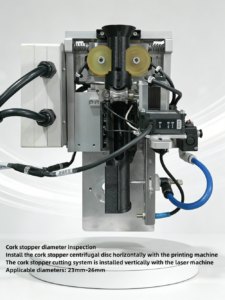
Cork Diameter Inspection Before Laser Marking
Cork diameter inspection is an important front-end quality-control process for manufacturers that need to remove unsuitable cork stoppers before printing or laser marking.
Natural cork is not a completely uniform material. Individual cork stoppers may contain knots, deformation, cracks, chipped edges, or incomplete sections. Different cork sizes or specifications may also become mixed during production and material transfer.
If these corks enter the marking machine without inspection, production capacity may be used to mark products that will later be rejected. Installing cork diameter inspection before marking helps prevent unsuitable corks from continuing into the value-added production stage.
Fangshiheng’s cork diameter inspection equipment can be integrated into the feeding section. The inspection module can be installed between sections of the cork centrifugal feeder, allowing feeding, inspection, rejection, and transfer to the marking machine to form one continuous process.
Common Quality Problems in Natural Cork Stoppers
Natural cork stoppers may have dimensional and material differences that affect downstream production.
Typical conditions include:
- Diameter outside the accepted range
- Deformed or oval cork bodies
- Knots in the natural cork material
- Cracks in the cork surface or body
- Chipped edges
- Incomplete or missing sections
- Bent cork stoppers
- Different cork sizes mixed in the same batch
These problems may influence cork feeding, positioning, laser marking, printing, counting, and packaging.
Mixed cork sizes are especially difficult to manage in an automated line. Even when the corks appear similar during manual observation, differences in diameter or shape may affect the next machine’s positioning and handling process.
A front-end cork diameter inspection system creates a quality-control point before unsuitable products reach the marking station.
Why Inspection Should Be Completed Before Marking
Laser marking and printing add value to the cork stopper. The production line should therefore avoid marking corks that will later be rejected because of incorrect dimensions or material defects.
When dimensional and material inspection is placed after marking, unsuitable corks have already occupied machine time and received the required logo, pattern, or production code. They must then be identified during a later inspection process.
Placing cork diameter inspection before marking changes this workflow.
Unsuitable corks are identified and rejected first. Accepted corks then continue to the marking machine. This allows the marking equipment to process a more consistent group of cork stoppers.
The main production benefits include:
- Preventing unsuitable corks from entering the marking machine
- Reducing marking work on products that cannot become finished goods
- Providing more consistent cork dimensions for positioning
- Reducing mixed-size corks in accepted batches
- Improving the proportion of acceptable products after marking
- Reducing defective products entering downstream pattern inspection
- Creating a clearer connection between feeding, inspection, and marking
The actual improvement depends on the cork material, inspection criteria, sample variation, and machine configuration. The system should be tested with actual cork samples before final performance is confirmed.
Installing the Inspection Module in the Feeding System
The Fangshiheng inspection module can be installed within the front-end feeding system instead of being arranged as a separate machine at the end of the line.
In this configuration, the cork centrifugal feeder supplies and separates the corks. The corks then pass through the diameter inspection position before they are transferred to the marking machine.
A typical workflow includes:
- Cork stoppers are loaded into the centrifugal feeder.
- The feeder separates and transfers the corks forward.
- Each cork passes through the integrated inspection position.
- The system checks the cork according to the confirmed inspection criteria.
- Unsuitable corks are directed to the reject outlet.
- Accepted corks continue directly to the laser marking or printing machine.
- Marked corks continue to pattern inspection.
- Approved products move to collection, counting, or packaging.
Integrating the inspection module into the feeding section saves production-line space and reduces unnecessary material transfer between separate machines.
The final installation position depends on the feeder structure, cork size, inspection method, outlet direction, and connection with the marking equipment.
Detecting Mixed Corks Before Production
Mixed materials or mixed cork specifications may appear during production, storage, or material transfer.
For example, corks with different nominal diameters may enter the same feeding batch. If they continue directly to marking, these differences may affect positioning, marking location, or final product classification.
Cork diameter inspection can identify products that fall outside the selected dimensional range. The rejection system then separates these corks before they enter the marking machine.
This function is useful for production lines that process several cork sizes. However, the machine changeover method and inspection settings for each cork specification must be confirmed during project evaluation.
If mixed corks cannot be distinguished by diameter alone, Fangshiheng should review whether additional visual features or inspection methods are required.
Inspection of Deformation and Natural Cork Defects
Diameter inspection is one of the equipment’s primary functions. Depending on the selected camera, lighting, software, and handling configuration, the system can also be designed to check additional cork conditions.
Inspection items may include:
- Oval or deformed cork bodies
- Bent cork stoppers
- Cracks
- Chipped or incomplete edges
- Missing material
- Selected visible surface defects
- Dimensional differences caused by knots or irregular material
Not every natural defect can be identified by the same inspection method. Surface texture, color variation, defect position, and cork orientation may influence the detection result.
For this reason, the required defect types must be clearly defined before the machine is configured. Sample testing should confirm which defects can be detected consistently and whether additional inspection methods are needed.
Reducing Defective Products Before Pattern Inspection
The front-end cork inspection system does not replace the downstream pattern inspection process.
Its purpose is to identify unsuitable corks before laser marking. Corks with incorrect diameters, deformation, cracks, chipped edges, incomplete sections, or mixed specifications can be rejected before entering the marking machine.
This prevents many defective corks from continuing to the laser marking stage. As a result, the downstream pattern inspection system receives a more consistent group of marked corks and does not need to process as many products that were already unsuitable before marking.
The front-end inspection and downstream pattern inspection perform different functions:
- Front-end inspection checks cork dimensions, shape, material condition, and mixed specifications.
- Downstream pattern inspection checks whether the marked logo, text, code, or graphic meets the required standard.
- Front-end rejection reduces the number of unsuitable corks reaching the marking and pattern inspection stages.
- Downstream inspection remains responsible for identifying missing, incomplete, unclear, misplaced, or otherwise unacceptable marking results.
Using both processes creates a clearer quality-control workflow. Material and dimensional defects are removed before marking, while marking quality is checked after the pattern has been applied.
Connection With Cork Laser Marking Equipment
After inspection, accepted corks can continue directly to the marking process.
Fangshiheng provides automatic CO2 cork marking equipment for different marking requirements. The production line can connect the feeder and inspection module with a dual-end CO2 cork laser marking machine or a CO2 cork stopper marking machine.
The appropriate machine depends on:
- Cork diameter and length
- Required marking positions
- Two-side or three-side marking requirements
- Logo, pattern, or code size
- Required production capacity
- Cork orientation
- Inspection and rejection method
- Downstream counting or packaging process
The feeding, inspection, and marking equipment should be planned as one material-handling workflow. This helps keep cork orientation, transfer height, production rhythm, and control signals consistent between machines.
Connection With Downstream Pattern Inspection
After laser marking, a downstream pattern inspection system can check the quality of the completed mark.
Depending on the confirmed inspection configuration, the system may check:
- Whether the required pattern is present
- Whether the pattern is complete
- Whether the marking position is acceptable
- Whether the logo, text, or code is clear
- Whether the marking result meets the approved sample
Because the front-end inspection has already removed many corks with dimensional and material defects, the downstream system can focus on evaluating the marked pattern.
This separates cork-body quality control from pattern-quality control and gives each inspection station a clearly defined task.
Connection With Counting and Packaging
After marking and pattern inspection, accepted corks may continue to quantity control and packaging.
A cork visual counting machine can control the number of corks released for each package. This is a separate function from cork diameter inspection.
Cork diameter inspection checks whether the cork meets the selected dimensional or defect criteria. Visual counting confirms the number of accepted corks sent to each batch or package.
For a more complete line, counted corks can continue to an automatic cork packaging machine for bagging, vacuum extraction, optional SO2 filling, sealing, and downstream carton handling.
A complete production process may include:
Feeding → Diameter and defect inspection → Laser marking or printing → Pattern inspection → Visual counting → Vacuum packaging → Carton handling
The actual machine order should be confirmed according to the factory’s quality-control, marking, and packaging requirements.
Production Value of Front-End Cork Inspection
The main value of front-end inspection is that it removes unsuitable corks before they occupy marking and downstream inspection capacity.
For cork producers, the system can support:
- Earlier identification of dimensional and material defects
- Separation of mixed cork specifications
- More consistent corks entering the marking machine
- Less marking work performed on unsuitable products
- Fewer defective corks entering pattern inspection
- Clearer division between material inspection and marking inspection
- Easier connection with counting and packaging equipment
- More organized quality control throughout the production line
The exact production result depends on the cork samples, defined defect types, inspection settings, feeding stability, and marking process.
No specific improvement percentage should be stated until the system has been tested under the customer’s actual production conditions.
What to Confirm Before Choosing the Machine
Before selecting a cork diameter inspection system, the buyer should provide detailed information about the cork and the required inspection standard.
Important information includes:
- Cork material type
- Cork length and nominal diameter
- Minimum and maximum accepted diameter
- Dimensional tolerance
- Cork sizes processed on the same line
- Types of mixed corks that must be identified
- Required detection of deformation or ovality
- Required detection of cracks, knots, or incomplete sections
- Acceptable and unacceptable sample corks
- Required production capacity
- Upstream feeding method
- Downstream marking or printing machine
- Pattern inspection requirements
- Reject collection method
- Available installation space
- Required production records or inspection data
Providing both acceptable and defective cork samples helps Fangshiheng evaluate the inspection method more accurately.
Fangshiheng Cork Inspection Solution
Fangshiheng provides cork feeding, diameter inspection, CO2 laser marking, printing-line integration, pattern inspection, visual counting, vacuum packaging, and carton-handling equipment.
The cork inspection module can be integrated into the feeding system so that unsuitable corks are removed before laser marking or printing. This arrangement creates a compact process and reduces repeated material transfer between separate inspection and marking stations.
For each project, Fangshiheng can review:
- Cork samples and dimensions
- Typical material defects
- Mixed-product conditions
- Inspection criteria
- Required production capacity
- Feeder structure
- Marking-machine interface
- Pattern inspection requirements
- Reject method
- Downstream equipment
- Workshop layout
The system can be supplied as a standalone inspection process or as part of Fangshiheng’s automated production equipment.
Buyers can also review the complete cork processing machinery range for feeding, marking, counting, packaging, and carton-handling equipment.
Contact Fangshiheng
If your production line needs to identify mixed corks, remove unsuitable cork stoppers before marking, or reduce the number of defective products entering downstream pattern inspection, Fangshiheng can evaluate a suitable inspection and automation layout.
Please provide cork dimensions, acceptable and defective samples, inspection criteria, required capacity, marking method, and photos or videos of the current production process.
Contact Fangshiheng to discuss an integrated cork feeding, inspection, laser marking, and pattern inspection solution.
Internal Links Included in the Article
- Cork Centrifugal Feeder: https://fangshiheng.com/project/cork-centrifugal-feeder/
- Dual-End CO2 Cork Laser Marking Machine: https://fangshiheng.com/project/fully-automatic-co2-dual-end-laser-marking-machine-for-cork-stoppers/
- CO2 Cork Stopper Marking Machine: https://fangshiheng.com/project/fully-automatic-co2-laser-marking-system-3-sided-cork-stopper-marking/
- Cork Visual Counting Machine: https://fangshiheng.com/project/automated-production-equipment4/
- Automatic Cork Packaging Machine: https://fangshiheng.com/project/cork-processing-machinery/
- Automated Production Equipment: https://fangshiheng.com/project_category/automated-production-equipment/
- Cork Processing Machinery: https://fangshiheng.com/project_category/cork-processing-machinery/
- Contact Us: https://fangshiheng.com/contact-us/
Facts to Confirm Before Publication
- Final English product name
- Inspection technology used by the current equipment
- Supported cork length and diameter range
- Confirmed diameter tolerance and inspection accuracy
- Confirmed production capacity
- Defect types the existing configuration can detect
- Whether knots can be detected directly or through dimensional or visual changes
- Whether crack and incomplete-section detection are standard or optional
- Method used to identify mixed corks
- Whether automatic rejection is standard
- Exact installation position within the feeding system
- Functions of the downstream pattern inspection system
- Whether production and inspection data can be recorded
- Available machine photos and operating videos
- Whether Automation Insights is the preferred WordPress category
Image and Video Suggestions
- Complete feeder with the integrated inspection module highlighted
- Close-up of corks passing through the inspection position
- Comparison of acceptable and rejected cork samples
- Examples of deformation, cracks, chipped edges, and incomplete corks
- Reject outlet separating an unsuitable cork
- Accepted corks entering the laser marking machine
- Downstream camera checking the completed marking pattern
- Full production line showing feeding, front-end inspection, marking, and pattern inspection
- Short video showing automatic feeding, front-end inspection, rejection, marking, and downstream pattern inspection
- Recommended image alt text: cork diameter inspection before laser marking