
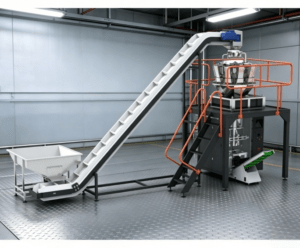
DXD-720T10 Automatic Weighing Packaging Machine for Small Bulk Parts
An <a href=”https://fangshiheng.com/project/dxd-720t10-automatic-weighing-packaging-machine/”>automatic weighing packaging machine</a> is used when small bulk products need to be packed by weight in a more stable and repeatable way.
For factories handling screws, fasteners, plastic parts, hardware accessories, or similar small components, manual weighing and packing can create unstable workflow rhythm. The DXD-720T10 Automatic Weighing Packaging Machine from Fangshiheng is designed to support weighing, bagging, sealing, and packaging-line organization for small industrial products.
It is not written as a general packaging concept. This article focuses on where this machine can be used, what buyers should confirm before selection, and how Fangshiheng can help match the machine to the real production process.
Problem: Small Bulk Parts Are Difficult to Pack Consistently
Small industrial parts often look simple to pack, but the actual production process can be demanding.
Products such as screws, fasteners, plastic pieces, and hardware accessories may be small in size, but they are usually produced in large quantities. If weighing and bagging depend too much on manual operation, several problems may appear.
Common issues include:
- Package weight may vary between bags.
- Operators may need to repeat weighing and adjustment.
- Packing speed may be difficult to keep stable during long shifts.
- Small parts may spill or accumulate around the packing area.
- The packaging step may become a bottleneck after upstream production.
- Downstream carton packing may not receive finished bags in a stable rhythm.
For this type of production, the packaging machine needs to support both weighing control and continuous bagging workflow.
Machine Process: How the DXD-720T10 Supports Packaging
The DXD-720T10 Automatic Weighing Packaging Machine is used for small bulk products that need weighing and bagging.
A typical process can include product feeding, weighing, bag forming or bag handling, filling, sealing, cutting, finished-bag discharge, and downstream transfer. The final structure should be confirmed according to the product shape, target bag type, and production layout.
The machine can be considered for:
- Screws
- Fasteners
- Plastic parts
- Small hardware parts
- Small bulk industrial products
- Other products that require weight-based packaging
The product page describes the machine as suitable for screws, fasteners, plastic parts, and other small bulk products requiring stable bagging. Before publishing any detailed specification, Fangshiheng should confirm the public parameters and tested product range.
Weighing Before Bagging
The weighing section is the key part of the packaging process.
For small bulk products, the packaging requirement is often based on target weight instead of piece-by-piece counting. The weighing system helps prepare the correct amount of product before it enters the bagging section.
This is useful when the product quantity inside each bag may vary by part size, weight, or material. Buyers should confirm the acceptable weight range, product weight variation, and bag requirement before choosing the machine configuration.
Bagging and Sealing
After weighing, the product needs to enter the bag smoothly.
The bagging and sealing section should be matched with the material flow, bag width, bag length, and finished package format. For small parts with edges, corners, or irregular shapes, the bag material and filling method should also be reviewed.
A good packaging process should reduce unnecessary manual adjustment and help finished bags move to the next step in an organized way.
Production Value for Small Parts Manufacturers
The value of an automatic weighing packaging machine is not only replacing manual work. It helps make the packaging process more repeatable.
For factories packing screws, fasteners, and small plastic parts, the DXD-720T10 can support:
- More stable weighing before packaging
- More organized bagging workflow
- Less repeated manual weighing and checking
- Better connection between production and final packing
- Easier arrangement of downstream carton packing
- A clearer packaging process for high-volume small parts
The actual production speed, weighing range, and packaging accuracy should be confirmed with Fangshiheng according to product samples and packaging requirements.
What to Check Before Choosing an Automatic Weighing Packaging Machine
Before choosing an automatic weighing packaging machine, buyers should prepare real product and packaging information.
Important points include:
- Product name and material
- Product size and shape
- Single-piece weight variation
- Target weight per bag
- Required bag size
- Required bag material
- Whether the product has sharp edges
- Whether product feeding needs customization
- Expected packaging workflow
- Downstream carton packing method
- Available workshop space
- Whether sample testing is needed
These details affect the feeding method, weighing configuration, bagging method, sealing structure, and final line layout.
Fangshiheng Solution
Fangshiheng provides <a href=”https://fangshiheng.com/project_category/automated-production-equipment/”>Automated Production Equipment</a>, packaging automation, weighing packaging machines, cork processing machinery, laser marking automation, and customized production-line modules.
For the DXD-720T10 Automatic Weighing Packaging Machine, Fangshiheng can review product samples, target bag weight, bag size, product flow, and workshop layout before recommending the machine configuration.
The machine can be used as a standalone packaging unit. It can also be reviewed as part of a wider packaging workflow, especially when finished bags need to move toward carton packing, carton sealing, or other downstream handling.
Buyers can also review Fangshiheng <a href=”https://fangshiheng.com/projects/”>Products</a> to compare this equipment with other packaging and automation solutions.
Contact Fangshiheng
If your factory needs to package screws, fasteners, plastic parts, or other small bulk products by weight, Fangshiheng can help evaluate whether the DXD-720T10 is suitable for your process.
Before inquiry, please prepare product samples, target bag weight, bag size, current packing method, production photos or videos, and any downstream carton packing requirements.
You can <a href=”https://fangshiheng.com/contact-us/”>Contact Fangshiheng</a> to discuss an automatic weighing packaging machine configuration for your small bulk product line.
Recommended Internal Links
- DXD-720T10 Automatic Weighing Packaging Machine: https://fangshiheng.com/project/dxd-720t10-automatic-weighing-packaging-machine/
- Automated Production Equipment: https://fangshiheng.com/project_category/automated-production-equipment/
- Products: https://fangshiheng.com/projects/
- Contact Us: https://fangshiheng.com/contact-us/
- Cork Processing Machinery: https://fangshiheng.com/project_category/cork-processing-machinery/
- Laser Marking Automation: https://fangshiheng.com/project_category/laser-marking-automation/
Image / Video Suggestions
- Hero image: DXD-720T10 machine front view with product feeding and bagging section visible.
- Detail image: weighing unit or material feeding section.
- Detail image: bagging and sealing section.
- Application image: screws, fasteners, or plastic parts prepared for weighing packaging.
- Short video: product feeding, weighing, bag filling, sealing, and finished-bag discharge.
- Suggested image alt text: DXD-720T10 automatic weighing packaging machine for small bulk parts.
Facts To Confirm Before Publishing
- Confirm whether “DXD-720T10 Automatic Weighing Packaging Machine” is the final public product name.
- Confirm supported product examples beyond screws, fasteners, and plastic parts.
- Confirm public weighing range, bag size range, speed, and accuracy only if approved.
- Confirm whether the machine uses roll film bag forming or another bag-handling method.
- Confirm approved machine photos and operation video.
- Confirm whether the article should stay under Product Updates.
- Confirm whether there is any real customer case. If not, do not describe it as a case study.