
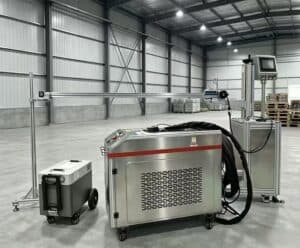
Laser Cleaning Machine for Industrial Metal Parts
A laser cleaning machine is used when metal parts need controlled surface cleaning before welding, coating, marking, assembly, or inspection.
In many factories, metal surfaces must be cleaned before the next production step. The surface may contain rust, oxide, oil, coating residue, or other contamination.
Manual cleaning can work for simple jobs. However, it becomes harder to control when the same part must be cleaned repeatedly. It also becomes harder when the cleaning result needs to match a defined production requirement.
Fangshiheng provides automated laser cleaning equipment for industrial metal parts. The machine can be configured with fixtures, motion control, safety protection, extraction, and line integration according to the actual workpiece and workshop process.
Problem: Manual Cleaning Can Be Hard to Repeat
Manual surface cleaning often depends on operator experience.
This can create variation between shifts, batches, and workstations. It can also make the cleaning process difficult to connect with automated production.
Common production issues include:
- Cleaning quality may vary between operators.
- Complex parts can be difficult to clean by hand.
- Some cleaning methods require consumables or extra handling.
- Parts may need to move between several workstations.
- The cleaned surface may not be stable before the next process.
- The cleaning step may become a bottleneck in the line.
For production managers and automation engineers, the key question is not only whether the surface can be cleaned. The more important question is whether the cleaning process can be repeated, controlled, and connected with the factory workflow.
How a Laser Cleaning Machine Works
A laser cleaning machine uses a laser beam to remove selected surface contamination from metal parts.
For Fangshiheng’s 500W Automated Continuous Laser Cleaning Machine direction, the process should be reviewed based on the real part sample, contamination type, cleaning target, fixture requirement, and line layout.
A Fangshiheng laser cleaning machine can be configured around the workpiece, cleaning target, fixture, and production-line layout.
A typical process includes sample review, positioning, laser cleaning path planning, safety protection, extraction, and downstream transfer.
Sample Review
Before machine configuration, the real workpiece should be reviewed.
This step is important because cleaning results depend on the base material, surface condition, contamination type, layer thickness, surface tolerance, and required finish.
For example, removing rust from a metal surface is different from removing oil, oxide, coating, or selected residue before a later process.
Fixture and Positioning
The part needs stable positioning before laser cleaning.
Fixture design is important when the cleaning area must stay consistent. It also matters when the workpiece has a curved surface, irregular shape, or limited cleaning window.
A good fixture helps keep the part steady during the cleaning process. It also helps the laser path reach the required surface area more reliably.
Laser Cleaning Path
The laser cleaning path should match the part surface and cleaning requirement.
For continuous cleaning applications, the scanning path, motion control, and part transfer method should be planned together. This helps the system clean the required area without unnecessary manual handling.
The path should be confirmed through testing before the final machine layout is approved.
Safety and Extraction
Laser cleaning equipment should be planned with safety protection and extraction requirements.
Depending on the project, the system may need an enclosure, viewing window, fume extraction, dust handling, or other protection design. These details should be reviewed before installation.
For general laser safety guidance, manufacturers can also refer to OSHA laser hazard information when planning workplace protection.
The final design should match the workpiece, cleaning material, workshop layout, and local safety requirements.
Automation Layout
The cleaning machine can work as a standalone unit or as part of a connected production line.
Depending on the project, the system can include loading, positioning, laser cleaning, visual checking, unloading, conveying, or connection with the next production step.
For factories that need a repeatable workflow, this layout review is as important as the laser source itself.
Production Value: More Controlled Surface Preparation
The value of a laser cleaning machine comes from process control.
When the machine, fixture, scanning path, and automation layout are designed around the actual part, the cleaning step becomes easier to repeat and inspect.
Possible production value includes:
- More stable cleaning workflow for repeated parts
- Less dependence on manual surface treatment
- Better control before welding, coating, marking, or assembly
- Easier integration with conveyors, fixtures, and production-line modules
- Cleaner process planning for parts with defined cleaning areas
- Better support for factories that need consistent surface preparation
Any exact cleaning speed, laser power effect, or surface result should be confirmed through sample testing before publication.
What to Check Before Choosing a Laser Cleaning Machine
Before choosing a laser cleaning machine, buyers should confirm the real production conditions.
Important points include:
- Base material of the part
- Contamination type
- Layer thickness
- Cleaning area and shape
- Required surface finish
- Surface tolerance after cleaning
- Part size and weight
- Fixture or clamping requirement
- Manual, semi-automatic, or fully automatic loading method
- Whether visual checking is required
- Whether the machine must connect with welding, coating, marking, or assembly
- Available floor space
- Dust, fume, and safety handling requirements
- Sample testing requirement
The cleaning target should be defined clearly before quotation or final design. A general request for “cleaning metal parts” is not enough for a reliable machine plan.
Fangshiheng Solution
Fangshiheng provides automated production equipment, laser marking automation, laser cleaning equipment, visual inspection, packaging automation, and custom production-line modules.
For laser cleaning projects, Fangshiheng can review the part sample, contamination type, cleaning target, and production process before recommending the machine configuration.
Relevant Fangshiheng equipment and application directions include:
- 500W Automated Continuous Laser Cleaning Machine
- Automated Production Equipment
- Laser cleaning for selected metal parts
- Fixture design for industrial parts
- Scanning path planning
- Loading and unloading automation
- Conveyor or line integration
- Custom automation line based on sample and workflow
For a standalone cleaning requirement, the machine can focus on positioning, laser cleaning, and collection.
For a connected production requirement, Fangshiheng can review whether feeding, conveying, visual checking, unloading, or downstream process integration should be included.
Fangshiheng can review whether your project needs a standalone laser cleaning machine or a customized automated cleaning line.
The final solution should be based on real samples, cleaning tests, required surface result, workshop layout, and the customer’s production process.
Contact Fangshiheng
If your production line needs more repeatable metal surface cleaning before welding, coating, laser marking, assembly, or inspection, Fangshiheng can help evaluate an automated laser cleaning solution.
Before inquiry, prepare part samples, material information, contamination details, cleaning target, current cleaning method, production process photos or videos, and available installation space.
With this information, Fangshiheng can check whether your project is suitable for a standalone laser cleaning machine or a customized cleaning and production-line solution.