
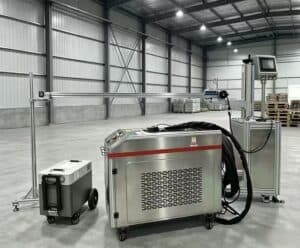
Laser cleaning for metal conveyor components requires more than selecting a laser power rating. The cleaning area, surface residue, component position, and access for operators all affect the station design.
Conveyor components can collect oil, oxide, coating residue, or other deposits during production and maintenance. When the same area must be cleaned repeatedly, the factory needs a process that can reach the required surface and produce a result that can be checked.
Fangshiheng lists a 500W Automated Continuous Laser Cleaning Machine in its Automated Production Equipment range. For conveyor applications, the cleaning method and machine layout should be confirmed through tests on the actual component and residue.
Define the Surface to Be Cleaned
A conveyor is made of different parts. A cleaning setup for a removable metal plate may differ from one for a fixed frame, roller, or chain component.
Before designing the station, identify the precise cleaning area. Record the base material, surface finish, residue type, and whether the component can be removed from the line. Also define what an acceptable cleaned surface looks like and how it will be inspected.
These details determine whether a fixed cleaning station, a fixture-based process, or a customized motion arrangement is appropriate.
Plan Positioning and Laser Access
The component must remain in a known position while the laser follows its cleaning path. For a removable part, a fixture can locate the surface and keep the cleaning area accessible. For a fixed conveyor component, the design must account for nearby guards, cables, moving parts, and available working space.
The laser path must cover the required area without relying on an operator to reposition the component during every cycle. Part shape, residue distribution, and access angle should all be reviewed during sample testing.
Include Extraction and Operator Protection
Laser cleaning can release material from the treated surface. Extraction and collection requirements therefore belong in the station design, alongside guarding and operator access.
The appropriate enclosure, extraction method, and maintenance access depend on the residue and installation site. A proposed station should show how operators load or access the component, how the cleaning area is protected, and how removed material is handled.
Decide How the Station Connects to Production
A cleaning machine may operate as a separate maintenance station or be integrated into a wider production workflow.
For a connected application, the factory should confirm when cleaning takes place, what signals permit the cycle to start, and what happens when the cleaning station is unavailable. Access for inspection and maintenance must also be considered in the layout.
The production benefit comes from a repeatable cleaning route: the component reaches a defined position, the system follows the approved path, and the result can be checked before the next process.
What to Check Before Choosing Equipment
Send Fangshiheng the actual component and process information, including:
- Base material and surface finish
- Type and thickness of residue
- Exact area to be cleaned
- Component dimensions and weight
- Whether the part is fixed or removable
- Required cleaning result and inspection method
- Available installation space
- Current cleaning method
- Required production or maintenance cycle
- Extraction and guarding requirements
The suitability of a 500W continuous laser configuration should be established by testing the actual surface. Cleaning speed and final surface condition should be reported only after that test.
Fangshiheng Solution
Fangshiheng can review the component sample, residue, cleaning target, fixture requirement, and workshop layout before proposing a station. The result may be a standalone cleaning unit or a customized arrangement with positioning, motion control, extraction, and line connection.
The 500W Automated Continuous Laser Cleaning Machine is listed among Fangshiheng’s automated production equipment. Buyers can also read the existing guide to laser cleaning industrial metal parts for a broader equipment-selection overview.
Contact Fangshiheng
If your factory needs to clean a defined area on metal conveyor components, provide a component sample or clear photos, details of the residue, the required surface result, and a video of the current process.
Contact Fangshiheng to discuss sample testing and a suitable laser cleaning station.
Recommended Internal Links
The links to Automated Production Equipment, the existing laser-cleaning guide, and Contact Fangshiheng are already placed in the article body.
Facts to Confirm Before Publication
- Which conveyor components have been tested with the 500W machine.
- Which residue types and base materials produced an approved result.
- Whether the proposed application is a standalone station or an installed line module.
- The tested cleaning area, cycle time, and inspection criteria, if these will be published.
- The approved extraction, guarding, and machine photos.
- Whether Automation Insights is the preferred WordPress category.
Image and Video Suggestions
Use a clear image of the actual machine and cleaning head for the featured image. Add close views of the metal component before and after a sample test, plus a short video showing positioning, the cleaning cycle, and result inspection. Suggested image ALT text: “laser cleaning for metal conveyor components”.