
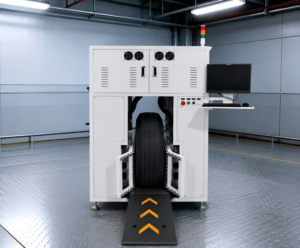
Tire Laser Marking: Handling and Positioning Large Tires
Tire laser marking is not only a question of laser power or marking content. For a large tire, moving the product into place and holding the sidewall at a repeatable marking position can be the harder part of the process.
A conventional marking station may require operators to lift, rotate, or reposition a heavy tire before each mark. If the tire is difficult to secure, the marking location can vary between products. These handling steps also take time that should be included when evaluating production output.
Start With the Tire, Not the Laser Specification
Before selecting a machine, define the full range of tires to be marked. Record outside diameter, width, weight, sidewall shape, and the location of each required mark. A fixture that works for a passenger tire may not provide the same access or support for a larger commercial tire.
The marking content also matters. DOT information, serial numbers, QR codes, and logos have different space and readability requirements. Sample marking should establish an acceptable result on the actual tire material and at the intended sidewall position.
Plan Loading and Positioning Together
The Fangshiheng Tire Laser Marking Machine can be evaluated with fixtures, conveyors, vision positioning, and loading or unloading options according to the production line. These options should be selected around the factory’s handling process; they should not be assumed to be included in every machine configuration.
The review should follow one tire through the complete cycle: arrival, loading, positioning, marking, inspection, and removal. Ask where an operator must touch or turn the tire and how the correct marking area is presented to the laser. If several tire sizes share the line, check the adjustment steps for each changeover.
Evaluate Production Value at Line Level
A faster laser cycle does not necessarily mean more marked tires leave the station. Handling and positioning can limit the overall rate, particularly with larger tires. The practical measure is the number of acceptable marked tires completed during a normal production run.
A suitable handling arrangement can reduce repeated manual repositioning and make the marking position more consistent. Its actual effect on output should be established through a trial using the customer’s tire sizes and marking content, not an unsupported percentage claim.
Fangshiheng’s Configuration Review
Fangshiheng can review tire samples or drawings, the required code or artwork, available floor space, and the upstream and downstream process. The marking station can then be considered within a wider laser marking automation layout, including the appropriate fixture and transfer method.
To discuss a project, provide the tire size and weight range, sidewall marking position, required content, target output, and a video of the current handling process. Contact Fangshiheng for a configuration review.