
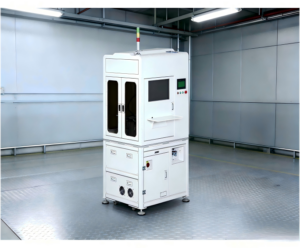
In high-volume cork manufacturing, marking speed is a direct driver of production capacity. When every second counts, a single-lane marking system can become a bottleneck that limits the entire production line’s output, affecting overall efficiency and profitability. For cork factories pursuing mass production and cost optimization, a high-speed, high-throughput marking solution is essential.
Suzhou Fangshiheng Precision Machinery Co., Ltd. introduces the automatic CO₂ dual-end cork laser marking machine — a dual-layer alternating marking system designed for cork factories that demand maximum throughput. Unlike sequential single-lane systems, this machine operates two independent production layers in alternating cycles, marking the top and bottom ends of 4 cork stoppers with every laser cycle. It breaks through the speed limit of traditional marking equipment, perfectly matching the high-volume production needs of modern cork processing factories.
This article explains the machine’s unique dual-layer architecture, technical specifications and ideal applications for high-volume cork manufacturers, helping you fully understand its core value and how it can optimize your production line.
1. Dual-Layer Alternating Marking Design
The key innovation of this machine is its two-layer alternating production configuration — an upper layer and a lower layer that work in coordinated alternation. This design eliminates idle time of laser sources, maximizes equipment utilization, and achieves ultra-high production efficiency that traditional single-lane machines cannot match.
Marking Process
-
Corks enter the machine through two separate feeding channels — an upper layer and a lower layer, ensuring stable and synchronized feeding.
-
High-precision vision system locates the cylindrical center of each cork, laying the foundation for accurate end-surface marking.
-
Layer 1 positions 4 corks for marking. Two 60W CO₂ RF laser sources — one on each side — emit simultaneously to engrave all 4 corks in a single pass, ensuring consistent marking quality and speed.
-
While Layer 1 is being marked, Layer 2 is already loading the next 4 corks into position, ready and waiting for the laser — no idle time between batches.
-
When Layer 1 marking completes, the laser switches to Layer 2 instantly — zero idle time for the laser system.
-
Layer 1 unloads marked corks and loads the next batch while Layer 2 is being engraved, forming a continuous and efficient production cycle.
This alternating dual-layer architecture eliminates all waiting time. The lasers operate continuously, switching between layers with no pause, achieving maximum utilization and the highest possible throughput — a critical advantage for high-volume cork production.
2. Two 60W CO₂ RF Lasers in Coordinated Collaboration
To match the high-speed dual-layer alternating design, this machine is equipped with two 60W CO₂ RF laser sources, positioned on opposite sides of the production layers. They work in synchronized coordination to ensure efficient and precise marking, with no pause for repositioning or adjustment.
|
Component
|
Specification
|
Function
|
|---|---|---|
|
Laser Source 1
|
60W CO₂ RF
|
Marks corks from one side of both upper and lower layers
|
|
Laser Source 2
|
60W CO₂ RF
|
Marks corks from the opposite side of both upper and lower layers
|
|
Configuration
|
One per side, covering both layers
|
Lasers never stop — continuous laser emission between layer alternation
|
Because the two lasers operate independently and cover both layers, there is no pause for repositioning. The system maintains continuous laser output across alternating layers, achieving maximum utilization and minimal cycle time, which directly drives the ultra-high hourly output of 10,000–12,000 corks.
3. High-Precision Vision-Based Cork Centering
Accurate end-surface marking depends on precise alignment of the laser beam with the cork’s cylindrical center. Even minor misalignment can lead to blurred marks, incomplete codes, or uneven engraving, affecting product quality and traceability. This machine uses a high-precision machine vision system to automatically locate and align each cork’s center axis before marking, ensuring consistent and high-quality results.
Key Functions of the Vision System
-
Captures the cork position in real time, adapting to slight variations in cork size and shape.
-
Calculates the exact cylindrical center coordinate with high precision, ensuring accurate laser positioning.
-
Adjusts the laser positioning accordingly, eliminating errors caused by manual alignment.
-
Ensures each mark is perfectly centered on the end surface, maintaining consistent quality across every production batch.
This intelligent centering system not only improves marking quality but also reduces the need for manual adjustment, further enhancing production efficiency and reducing labor costs.
4. Technical Specifications
|
Specification
|
Value
|
|---|---|
|
Laser Type
|
CO₂ RF Metal Tube, 60W × 2
|
|
Marking Configuration
|
Top end + bottom end (dual-end)
|
|
Production Layers
|
2 alternating layers (upper + lower)
|
|
Corks per Laser Cycle
|
4 corks
|
|
Production Speed
|
10,000–12,000 corks/hour
|
|
Cork Diameter Range
|
38mm × 23mm to 54mm × 26mm
|
|
Marking Depth
|
0.01–0.3mm adjustable
|
|
Positioning
|
High-precision vision-based cylindrical centering
|
|
Cooling
|
Closed-loop water chiller (ensures stable laser operation and long service life)
|
|
Control Interface
|
7-inch HMI touch screen, PLC controlled (easy to operate and adjust parameters)
|
5. Dual-End vs 3-Sided Comparison
Choosing the right marking machine depends on your production needs, product positioning and market demands. Below is a detailed comparison between our dual-end marking machine and 3-sided marking machine, helping you make the optimal choice.
|
Feature
|
Dual-End Machine
|
|
|---|---|---|
|
Marking Coverage
|
Top end + bottom end
|
360° body + top end + bottom end
|
|
Laser Source
|
2 × 60W CO₂ RF
|
30W + 60W CO₂ RF
|
|
Production Architecture
|
Dual-layer alternating
|
Single-lane sequential
|
|
Corks per Laser Cycle
|
4
|
1
|
|
Production Speed
|
10,000–12,000/hour
|
3,000/hour
|
|
Vision Centering
|
Yes
|
No
|
|
Cork Body Marking
|
No
|
Yes — 360° wrap-around
|
|
Best For
|
High-volume standard corks
|
Premium branded corks
|
Choose the Dual-End Machine When:
-
Production volume exceeds 10,000 corks per hour
-
End-surface marking is sufficient (no body branding required)
-
Speed and throughput are the top priorities
-
Multiple cork sizes need quick changeover
Choose the 3-Sided Machine When:
-
Premium full-body branding is required
-
Customers demand 360° decorative patterns
-
Lower volume but higher per-unit value
6. Production Line Integration
The dual-end marking machine is designed as a seamless integration module for existing cork production lines, with a high output of 10,000–12,000 corks/hour, ensuring it does not become a bottleneck in the entire production process. It supports unattended operation, reducing manual handling and improving overall line efficiency.
Upstream Connection
-
Cork centrifugal feeder (split feed to 2 layers, ensuring synchronized feeding for both upper and lower layers)
-
Cork diameter inspection machine (pre-screened qualified corks, reducing marking defects and improving product yield)
Downstream Connection
Direct output to cork visual counting machine + automatic cork packaging machine integrated unit. The marked corks from both layers are merged into a single downstream flow, ensuring smooth connection with subsequent processes and maintaining the high-speed production rhythm.
With its 10,000–12,000 cork/hour output, this machine easily feeds high-speed counting and packaging equipment without creating a bottleneck, realizing end-to-end automated production from feeding to packaging.
7. Marking Durability
CO₂ RF laser marking produces permanent, high-contrast marks that are non-toxic and food-contact safe — critical for wine corks that come into direct contact with beverages. The marks can withstand harsh conditions during storage and transportation, ensuring long-term legibility and brand integrity.
Key durability features:
-
Resistant to alcohol and wine exposure, no fading or discoloration
-
Stable under cellar humidity (55%–80% RH), no deformation or peeling
-
Withstands mechanical handling during transport and packaging
-
Maintains clarity during long-term storage, meeting international traceability requirements
8. Applications for Cork Manufacturers
This machine is specifically designed for high-volume cork production scenarios, catering to the needs of factories pursuing efficiency, cost optimization and standardized production. It is an ideal solution for:
-
High-volume standard cork production: Bulk orders with basic end marking (batch codes, production dates, traceability codes)
-
Multi-shift factories: Continuous production at maximum throughput, adapting to 24-hour unmanned operation
-
Export cork manufacturers: Compliance with international traceability marking standards, facilitating global market access
-
Contract processors: Fast changeover between different client end marks, improving operational flexibility
-
Economy to mid-range cork lines: Where per-unit cost and speed are critical, helping reduce production costs and improve market competitiveness
9. Maintenance Schedule
To ensure long-term stable operation and extend the machine’s service life, we recommend following this regular maintenance schedule. The machine’s modular design and easy-access components make maintenance simple and efficient, reducing downtime and operational costs — a key consideration for high-volume production facilities.
|
Task
|
Frequency
|
|---|---|
|
Clean laser lens and protective windows (both lasers)
|
Every 8 hours
|
|
Check cooling water level
|
Weekly
|
|
Replace air filters
|
Monthly
|
|
Lubricate dual-layer rotary fixtures
|
Monthly
|
|
Replace CO₂ RF laser tube
|
Every 10,000–12,000 operating hours
|
Conclusion
The automatic CO₂ dual-end cork laser marking machine from Fangshiheng sets a new benchmark for high-speed cork marking. Its dual-layer alternating architecture, two 60W CO₂ RF lasers and precision vision-based centering deliver a production capacity of 10,000–12,000 corks per hour — far exceeding conventional single-lane systems. It solves the bottleneck problem of traditional marking equipment, helping high-volume cork manufacturers improve efficiency, reduce costs and enhance market competitiveness.
For cork manufacturers who prioritize throughput and efficiency, this machine is the optimal choice for standard end-surface marking. When full 360° body branding is required, our 3-sided marking machine remains the recommended solution for premium applications. We provide one-stop customization and after-sales service, tailoring the most suitable marking solution according to your specific production needs.
Contact Us
Contact Suzhou Fangshiheng Precision Machinery Co., Ltd. to discuss which marking solution best fits your production requirements and get a customized quote.
Tel: +86 18921980039 Website: https://fangshiheng.com